
GPT-6.2 doesn't cache the instructions field: where your system prompt belongs
From GPT-6.2, OpenAI bills top-level instructions at the uncached rate on every request. What changed, who it caught, and how to check your agents and gateways.
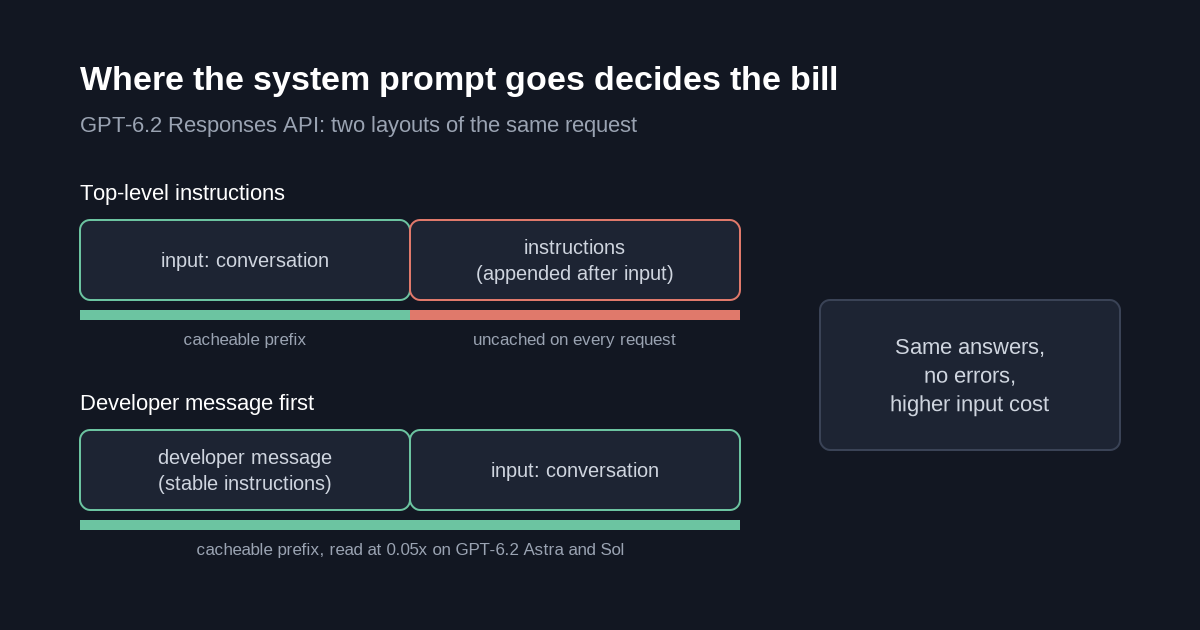
A system prompt that used to be cached can now be billed in full on every call, without any error. With GPT-6.2, OpenAI changed where the Responses API puts its top-level instructions field, and as a result those tokens are no longer eligible for prompt caching. Nothing fails, and the answers are the same. Only the input bill moves. If your agents, or the gateway in front of them, send a long system prompt through instructions, this is worth checking today.
What OpenAI changed
The Responses API accepts developer guidance in two places: the top-level instructions parameter, or a developer message at the start of input. OpenAI's GPT-6.2 guide now says that "models starting with GPT-6.2 append top-level instructions after input". Because prompt caching works on an unchanged prefix, anything appended after the input sits outside the cacheable part.
The prompt caching guide spells out the billing: OpenAI "bills those instruction tokens at the uncached input-token rate on every request, even if you repeat identical instructions". The fix it gives is to put reusable instructions in a developer message as the first item of input. Top-level instructions are now meant for guidance that applies only to the current request, such as asking for a summary on a workflow's last turn. They can change between turns without disturbing the cached prefix, and they don't carry over with previous_response_id.
Why the difference is large on GPT-6.2
The same caching guide lists cache reads at 0.05 times the uncached input rate for GPT-6.2 Astra and Sol (0.1 times on most other models from GPT-5.6 onwards). A prompt that should have been read from the cache at one twentieth of the price is instead billed in full. For an agent that sends a 10,000-token system prompt on every turn, once the prefix is cached that is the difference between paying for 500 token-equivalents and paying for 10,000 on each call, before any conversation history is counted.
Who it caught
The change is documented, but it is easy to miss because the old layout still works. LiteLLM, the open-source LLM gateway, published an incident write-up on 19 November. When it translates Chat Completions or Anthropic-format Messages requests into Responses API calls, it put the system prompt in instructions. According to the write-up, that was cached the same way as a developer message up to GPT-6.1, so the choice made no difference until now.
LiteLLM lists the affected paths: /v1/chat/completions traffic to a GPT-6.2 deployment that uses the Responses API, and /v1/messages traffic to GPT-6.2, for example from Claude Code or another Anthropic-format client pointed at GPT-6.2 through the gateway. Its fix moves the system prompt into a leading developer message and is backported to five release lines (1.106, 1.108 LTS, 1.109, 1.110 and the 1.111 release candidate); the write-up lists the exact versions.
Two details from the write-up generalise. No error alert fired, because nothing errored; a customer noticed the missing cache hits the next day. And LiteLLM describes the change as a breaking change released on 17 November, while OpenAI's guides present it as how models from GPT-6.2 onwards behave, without a separate change notice in the pages we read. Whichever way you read it, the practical effect is the same.
Analysis: cost regressions that look like success
Most monitoring watches for failures: error rates, latency, refusals. A caching regression produces none of them. The request succeeds, the model answers well, and the only signal is a lower cache hit rate and a higher input token bill, which most teams look at weekly or monthly, if at all.
This one also hides in layers. An application may never touch the instructions field itself, but an SDK, a framework or a gateway translating between API formats may choose it. Anyone running Anthropic-format coding tools against OpenAI models through a translating gateway is one translation step away from the request OpenAI actually sees.
It also adds to a pattern. GPT-6.2's guide lists other prefix-sensitive behaviour, such as reasoning items being dropped after edits to earlier conversation history. Each release tends to bring rules about what must stay stable at the start of a prompt. Earlier articles covered OpenAI's 12-hour cache and its write price and why most teams don't measure prompt caching; this change is a case where measuring it is the only way to notice.
What it means for engineering and security leaders
Treat a model upgrade as a cost change to verify, not only a quality change. For GPT-6.2 specifically, the check is simple: compare cached input tokens as a share of input tokens before and after moving traffic to the new model, per application or gateway route. A sharp drop with no change in prompts points at request layout.
If you run a gateway, find out where it puts the system prompt for each provider and model, and whether you are on a release that handles GPT-6.2. If you call the API directly, check whether your SDK or framework sets instructions for you.
Where SpanDock fits
SpanDock's AI enablement report includes the prompt cache hit rate among its value measures, compared with the period before, and is built from the telemetry the server already holds without reading prompt text. That lets you compare the hit rate across periods, for example before and after a model change, next to spend per session. The report is on the Premium and Enterprise plans.
Practical takeaways
- Search your code and configuration for the Responses API
instructionsfield on GPT-6.2 requests, and move stable system prompts into a leadingdevelopermessage. - Keep
instructionsfor per-request guidance that is meant to change, as OpenAI's guide now recommends. - Upgrade gateways that translate requests to the Responses API; LiteLLM users should move to the fixed release for their line.
- Watch cache hit rate per model, not only overall, and compare it before and after any model switch.
- Alert on cost signals, such as cached tokens as a share of input, not only on errors.