
Mendix Studio Pro's MCP server listened beyond localhost: two CVEs to fix
Studio Pro's built-in MCP server could be reached from the network and from web pages. What the two November CVEs cover, how severe they are, and what to check.
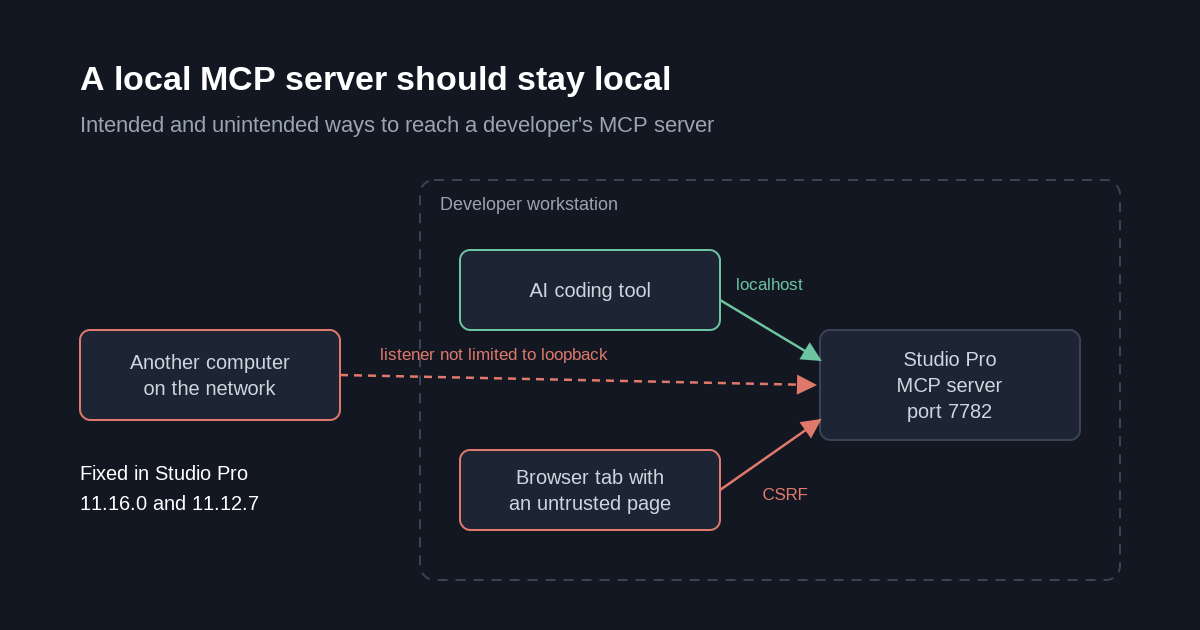
A local MCP server is supposed to be local. Siemens' advisory SSA-710379, published on 10 November 2026 and republished by CISA on 17 November, describes two flaws in the MCP server built into Mendix Studio Pro, the low-code development environment. One let the server be reached from other machines on the network; the other let a web page in the developer's browser send it requests. Both are fixed in current releases. They are also a useful checklist for any MCP server that runs on a developer's computer.
What the Studio Pro MCP server does
According to Mendix's documentation, the MCP server is available from Studio Pro 11.10 and is switched on under Preferences → AI → MCP Server. It lets external AI tools, such as coding assistants, use the capabilities of Maia, Studio Pro's built-in AI assistant, on the app that is open. Changes made through it appear in Studio Pro in real time. The documentation's example connects Claude Code to it over HTTP on localhost.
That is a powerful server to expose: the tools it offers change an application's domain models and microflows. The intended design is that only programs on the same computer can call it.
The two vulnerabilities
CVE-2026-112136: binding to an unrestricted address. The advisory says the MCP server "does not properly restrict its HTTP listener to the loopback interface", so an attacker with network access could interact with it remotely. Siemens rates it CVSS 3.1 8.8 (high) and CVSS 4.0 9.2 (critical).
CVE-2026-112137: cross-site request forgery. The server did not properly validate the Content-Type and Origin headers of incoming requests, so "a malicious web page" could make the developer's browser send it requests. Siemens rates it CVSS 3.1 5.4 (medium) and CVSS 4.0 5.1 (medium).
The summary covers both: the result could be "unauthorized data access, tool execution, or system compromise".
Affected and fixed versions
| Release line | Affected | Fixed in |
|---|---|---|
| Studio Pro 11 | 11.15.0 up to, not including, 11.16.0 | 11.16.0 |
| Studio Pro 11.12 | 11.12.6 up to, not including, 11.12.7 | 11.12.7 |
One gap is worth noting: Mendix documents the MCP server from 11.10, while the advisory lists affected versions from 11.15.0 and 11.12.6. The advisory doesn't explain why earlier versions with the feature are not listed, so we don't speculate; if you run an older release with the MCP server on, check with Mendix rather than assume.
Severity depends on the scale
The two scores for CVE-2026-112136 put it in different bands: high under CVSS 3.1, critical under CVSS 4.0. The vectors also differ on user interaction, which CVSS 3.1 marks as required and CVSS 4.0 as not required (with attack prerequisites present instead). Mendix's own security advisories page lists only the 3.1 score of 8.8, and CISA's republication shows 8.8 in its summary. A team that triages only on "critical" may see it or miss it depending on which feed it reads.
Mitigations if you can't update yet
The advisory gives one mitigation for each flaw:
- Network exposure: keep inbound firewall rules that block external traffic to port 7782. Siemens notes this "is already the case by default on standard Windows installations". If remote access is genuinely needed, use an authenticated channel such as a VPN or SSH tunnel rather than opening the port.
- Browser requests: use a Chromium- or WebKit-based browser with Private Network Access protections enabled, or an extension that stops external sites from sending requests to
127.0.0.1.
The first depends on every developer's firewall being as the default left it. The second depends on browser settings that are not under the developer's control in every organisation. Updating is the fix.
Analysis: the two classic mistakes of local servers
Neither flaw is specific to AI. Binding to all interfaces instead of loopback, and trusting any request that arrives on localhost, are long-standing mistakes in local development servers. What is new is what sits behind them. A local MCP server's tools are designed to be called by an agent with broad authority over a project, so a request that reaches it is a request to change the project.
The browser path matters most for developers. A developer's browser visits many sites; if any of them can send requests to a port on the same machine, the local server is only as private as the least trustworthy page that is open. The MCP specification's Streamable HTTP transport addresses exactly this pattern: servers must validate the Origin header, should bind only to localhost when running locally, and should authenticate all connections. Earlier articles covered the same theme in MCP Inspector's advisories and in MCP servers that trust the wrong URLs.
What it means for engineering and security leaders
If your teams build on Mendix, find out which Studio Pro versions are installed and whether the MCP server is switched on. Then extend the question: which other development tools now ship a local MCP server, and on which addresses and ports do they listen? IDEs, low-code platforms and design tools are adding these quickly, and each one is a new listening service on developer machines that asset inventories may not know about.
Where SpanDock fits
SpanDock's MCP gateway can be set to Enforced on computers, which adds SpanDock's MCP server to the AI tools it configures and reports, or moves aside, those tools' other MCP servers. That shows where a tool such as Claude Code has been pointed at another local server, like Studio Pro's. The MCP gateway is on the Premium and Enterprise plans.
Practical takeaways
- Update Studio Pro to 11.16.0 or later, or 11.12.7 or later on the 11.12 line.
- Check the firewall on developer machines blocks inbound traffic to port 7782 until every install is updated.
- Turn the MCP server off where it isn't in use; it is an opt-in preference.
- Inventory local MCP servers across development tools, and check each binds only to loopback and validates
Origin. - Triage on both CVSS versions when advisories give two scores.
Sources
- Siemens ProductCERT SSA-710379: Multiple vulnerabilities in Mendix Studio Pro's MCP Server
- CISA ICS advisory ICSA-26-321-05: Siemens Mendix Studio Pro
- Mendix documentation: Studio Pro MCP Server
- Mendix documentation: Security advisories
- Model Context Protocol specification (2026-07-28): Streamable HTTP transport, security