
HKMA's agentic AI paper: intent, kill switches and a registry of agents
Hong Kong's banking regulator asks how banks should govern AI agents, including a registry of material agents. What it proposes, and what it doesn't.
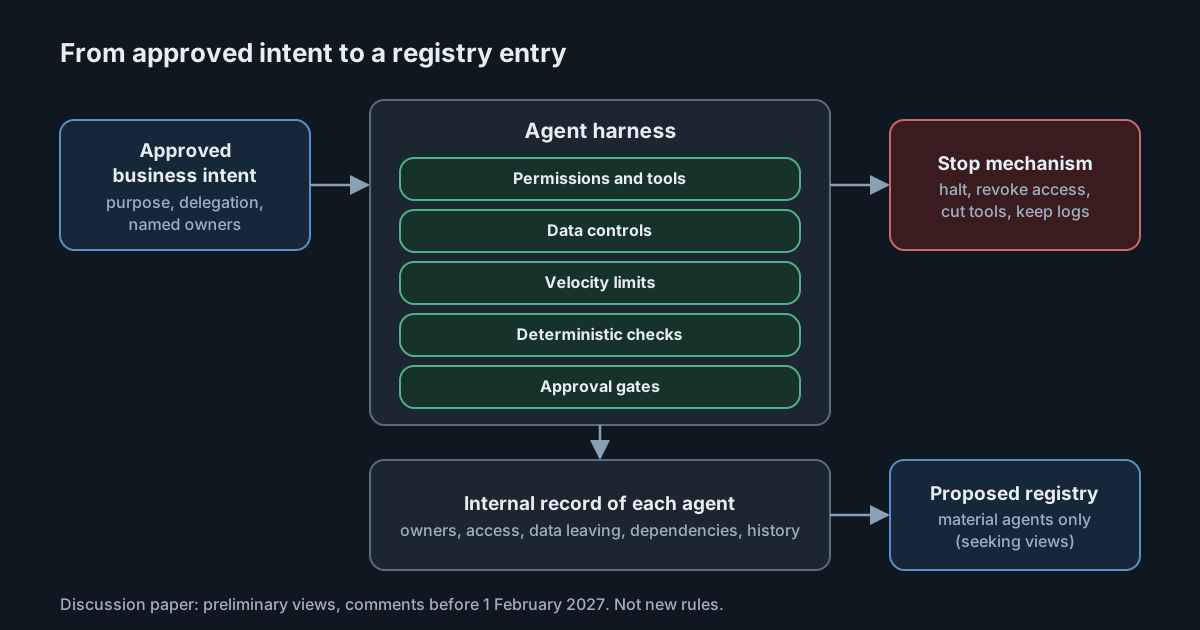
On 2 November 2026 the Hong Kong Monetary Authority (HKMA) published a discussion paper on how banks should govern agentic AI. It does not set new rules, but it is one of the most concrete regulator documents yet on what controlling an AI agent should look like in practice: an approved purpose for every agent, controls built into the agent's harness rather than its prompt, a working stop mechanism and, for the most important agents, a proposed registry held by the regulator. If you build or run agents for a bank, or sell tools to one, it is worth reading now, while comments are open.
What was published
The press release for Hong Kong FinTech Week 2026 announced the paper alongside Project SAGE, a programme on agentic finance, and a cross-sectoral expert group. The Discussion Paper on Agentic A.I. Governance in the Banking Sector is dated November 2026 and invites comments from the industry before 1 February 2027.
Its status matters. The paper says it "presents preliminary views and invites comment", that it is "not a statement of supervisory expectations", and that it creates no new obligations. Treat it as a direction of travel, not a compliance deadline. One reading note: in HKMA documents, "AI" usually means an authorised institution (a bank), while "A.I." is the technology.
The core idea: intent-anchored accountability
The paper's organising principle is that an agent should act only in pursuit of an approved business intent, within a defined delegation of authority, and that accountability for that delegation stays with identified people and functions in the bank. Before deployment, the bank defines what the agent is for, specifically enough to assess risk, design controls and oversee it afterwards.
This is a useful framing for engineering teams because it turns a vague question ("is this agent safe?") into a testable one: is the agent doing what it was approved to do, with the access it was approved to have, and can we show it?
Controls in the harness, not only in the prompt
The paper calls the surrounding machinery a risk-integrated agent harness. The bank translates its risk tolerances into boundaries specific to each agent, and the paper lists the layers that can carry them: instructions, workflow design, permissions, tools, interfaces, data controls, dynamic guardrails, velocity limits, deterministic validation checks, approval gates, monitoring and escalation. It asks how risk appetite can become "practical, testable and enforceable controls".
The point that carries over to any organisation is that a system prompt is one control among many, and the weakest one to rely on alone. Permissions on tools, limits on how fast an agent can act and deterministic checks on its output can be tested; an instruction in a prompt can only be hoped for.
Human oversight and the stop mechanism
The paper accepts that oversight will vary. Some use cases may need human approval before every action; others may suit human-on-the-loop arrangements, provided the bank can still understand, challenge, constrain, pause or withdraw the agent. It even mentions using one A.I. system to help oversee another.
What it is firm about is an effective stop mechanism, the "kill switch". Depending on the architecture, that may mean halting tasks, revoking access or credentials, disabling connections to external tools, pausing outbound communications, switching to a fallback process and preserving logs. It also seeks views on a supervisory approach where risks aren't managed, ranging from engagement and remediation to restrictions and, in exceptional cases, suspension of the agent.
For engineers, a stop mechanism that only exists on a slide is the common failure. If revoking an agent's credentials means finding which of a dozen tokens it holds, it isn't a switch.
A proposed registry of material agents
The most novel proposal is a registry. Banks would keep up-to-date internal records of material agents and submit information on them to a central registry, "such as one maintained by the HKMA". The paper suggests the record might cover:
- the agent's purpose, intended use and deployment status;
- its business, technical and control owners, and authorised users;
- its capabilities and access, including data that leaves the bank and who receives it;
- its infrastructure and dependencies, including those shared with other deployments;
- its stop mechanism, fallback arrangements and where its logs are;
- its change and suspension history, and what happens to memory, state and credentials at retirement;
- its materiality assessment, the rationale and the next review date.
A deployment would be material where its misbehaviour, compromise or failure could significantly harm customers, the bank's safety and soundness or its critical operations. The paper asks whether notice should come before deployment or within a set time after, whether a central supervisory registry or a secure industry arrangement would work better, and it says the HKMA does not envisage a public registry. It also expects the registry to build on the inventory of approved A.I. use cases that banks already keep under the HKMA's existing guidance.
Beyond the bank's walls, the paper proposes approving external connections in advance, treating external content as untrusted, and a "Know Your Agent" approach to establishing an outside agent's identity, principal and delegated authority.
A same-week contrast from the United States
Two days later, the US Office of the Comptroller of the Currency issued Bulletin 2026-54, a supervisory framework for what US federal usage now calls "Super Intelligence" (the bulletin uses it for technologies previously termed "Artificial Intelligence" in US law, citing an October 2026 executive order). It is a resource for examiners, not a statement of expectations for banks. It says such technology is not a separate risk category needing its own risk appetite, and that control intensity should scale with the consequences of an agent's failure or misuse, judged by consequences, transfer of agency and human oversight rather than technical sophistication.
The two documents differ in form, but agree on substance: classify agents by what they can affect, and scale controls to match. Only the HKMA paper proposes telling the regulator which agents you run.
What it means for engineering and security leaders
Even outside banking, the registry fields are a good checklist for any agent with real access. Most teams can't answer several of them today, particularly "what data leaves, and to whom", "what is shared with other deployments" and "what happens to its credentials when we turn it off".
The harness framing also settles an internal argument. If controls are expected to live in permissions, limits and approval gates, then the platform team that owns those layers owns much of the agent's risk, not only the team that wrote the prompt.
Practical takeaways
- Write down each agent's intent. One paragraph per agent: its purpose, what it may touch, who owns it and who may use it.
- Test the stop mechanism. Time how long it takes to halt an agent, revoke its credentials and cut its tool connections. Keep the logs.
- Move controls out of the prompt. For each risk you rely on a prompt to prevent, look for a permission, limit or deterministic check that does the same job.
- Map shared dependencies. List the models, connectors and credentials that more than one agent relies on.
- Comment if you're affected. Comments go to the HKMA before 1 February 2027; the address is in the paper.
For changes that agents make to production systems through the MCP gateway, SpanDock's change management report records who made each change, what approved it and the ticket, lists exceptions such as changes with no approval first, and exports with a checksum for auditors. It is on the Enterprise plan. It covers only calls through the gateway, so it is one part of the record, not the whole registry entry. For an earlier regulator view of autonomous agents, see what the Bank of England told firms about autonomous AI risk.