
Hong Kong's ART framework: AI inventories, owners and kill switches for banks
The HKMA replaced its 2019 AI principles with the ART framework and a concept note on agentic AI. What it expects, and what engineering teams will be asked for.
On 15 October 2026 the Hong Kong Monetary Authority published its "ART" framework for the responsible adoption of AI by banks. The letters stand for Accountability, Resilience and Trust. The package replaces the HKMA's 2019 high-level principles with more specific supervisory guidance, adds a report of lessons from its generative AI sandbox, and includes a concept note on governing AI agents. It applies to authorised institutions in Hong Kong. Its requirements are written for banks, but they read like a specification for the engineering controls any regulated firm will be asked about once AI tools are in daily use.
What was published
The covering circular to all authorised institutions describes three annexes:
- Annex A, the supervisory guidance. It sets out the HKMA's expectations under the three pillars and supersedes the "High-level Principles on Artificial Intelligence" of 1 November 2019. It says it also draws on the Financial Stability Board's report on sound practices for responsible AI adoption, issued the same day.
- Annex B, a practical insights report from the second cohort of the HKMA's GenAI sandbox, with examples of how the principles may be applied.
- Annex C, a concept note on the governance of agentic AI. It is explicitly preliminary and "does not constitute specific supervisory requirements at this stage".
The press release also announces an AI training data sharing platform and further sandbox work. It describes a discussion paper on agentic AI governance as forthcoming; the circular says the HKMA "will shortly issue" it. At the time of writing it has not been published.
Two wording points are worth noting. The press release quotes a Deputy Chief Executive referring to "Accountability, Resiliency and Trust", while the guidance itself uses "Resilience". And the guidance asks institutions to apply it proportionately, according to the materiality and risk of each use case, rather than uniformly.
What the guidance asks for
Annex A has nine principles. Several translate directly into artefacts an engineering organisation would have to produce.
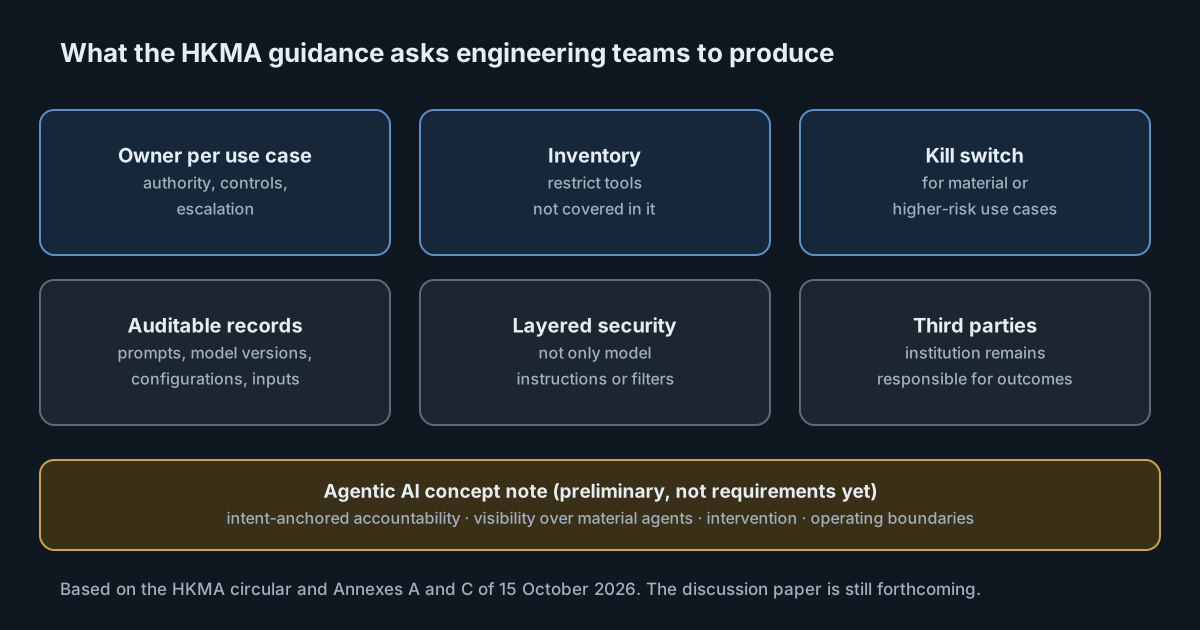
An owner for every use case. Each deployed AI use case needs an assigned owner, responsible for defining the system's authority, overseeing its controls and monitoring, and escalating issues. Human oversight can be "human-in-the-loop", "human-on-the-loop" or "human-in-command", chosen by risk, and the people doing it need the competence, information, time and authority to override or stop the system.
An inventory, and controls on what isn't in it. Institutions are expected to maintain an up-to-date inventory of approved AI use cases and to "restrict the use of solutions not covered in the inventory". The inventory should cover purpose, owner, provider and model, risk classification, lifecycle and approval status, dependencies, and key controls. It explicitly includes third-party and embedded AI, not only systems built in-house, and the guidance asks for controls to manage "shadow A.I.". A footnote adds that for third-party tools, institutions should comply with contractual and licensing terms and implement controls against circumvention.
A kill switch for material use cases. Response and recovery arrangements must allow an institution to contain, suspend or decommission a use case that behaves wrongly. For more material or higher-risk use cases, "a kill switch or equivalent should be built-in", enabling suspension, access revocation and prevention of further actions.
Auditable records. Documentation should cover the whole lifecycle: risk assessment, testing, approvals, deployment and material changes. For higher-risk outputs, records for auditing and outcome tracing should be kept where practicable, and for generative AI the guidance gives prompts, model versions, configurations and inputs as examples.
Layered security that doesn't trust the model. The cyber risk section names data poisoning, prompt injection and safeguard bypass, and says institutions "should not rely solely on model instructions or filters" for assurance.
Third parties stay your responsibility. Where an external provider delivers an AI use case, the institution "remains responsible for all A.I.-generated outcomes", and should assess concentration, substitutability and exit risk.
The agentic AI concept note
Annex C is short and tentative, but it shows where requirements are likely to go. It sets out four ideas:
- Intent-anchored accountability. An agent's actions should be traceable to the business intent behind them, and that intent defines both the agent's authorised scope and who is accountable. The note suggests the business function that owns the intent, not the technology team, would generally be the accountable owner.
- Visibility over material agents. An inventory of material agents, with clear lineage of the models, data, tools and services they depend on. The HKMA says it is also exploring an industry-level registry of material agents deployed by banks.
- Human oversight and intervention. Active monitoring, defined points where human approval is needed, and intervention measures such as suspending an agent's access to particular tools or an emergency stop.
- Operating boundaries. Clearly defined tools, systems and data each agent may use, which the note says may be supported by a "risk-integrated agent harness".
The press release says more than 60% of the second sandbox cohort's use cases explored agentic AI, which explains why the HKMA chose to publish a direction of travel before a formal paper.
What it means for engineering and security leaders
For banks in Hong Kong, the guidance asks institutions to uplift policies and controls "in a timely manner", without a fixed deadline in the documents we read. For everyone else, it is one more regulator converging on the same short list: know what AI is running, name an owner, be able to stop it, and keep records that let you reconstruct what happened.
AI coding tools fit awkwardly into a use-case inventory. They are third-party, they run on many laptops, they change models frequently, and individual developers often add their own. An inventory that only lists the tools procurement approved will miss the ones that matter for "shadow A.I.". The kill-switch expectation is also harder than it sounds: revoking a provider key stops one route, but an agent that holds other credentials keeps working.
Practical takeaways
- Make the inventory observable, not declared. Combine the list of approved tools with evidence of what actually runs on developer machines and what calls model providers.
- Record the fields the HKMA names. Purpose, owner, provider and model, risk class, approval status, dependencies and key controls are a reasonable schema even outside banking.
- Test the stop button. For each material agent, write down how you would suspend it, revoke its access and prevent further actions, then rehearse it.
- Write down each agent's boundaries. Tools, systems and data it may touch, in configuration rather than in a prompt, so the "not solely model instructions" expectation is met.
- Keep prompts and model versions where risk warrants it, under your data protection and retention rules.
For related reading, see our OWASP agentic applications checklist and our note on the Bank of England's view of autonomous AI cyber risk.
SpanDock's process inventory shows which AI tools run on your team's computers, including ones that send no telemetry, from periodic snapshots of running processes; it never collects command-line arguments, environment variables or open files. It is on the Enterprise plan.
Sources
- HKMA press release: HKMA announces "ART" Framework to promote responsible A.I. adoption (15 October 2026)
- HKMA circular B1/15C: Responsible Adoption of Artificial Intelligence (15 October 2026)
- HKMA Annex A: Supervisory Guidance for Responsible Adoption of Artificial Intelligence
- HKMA Annex C: Concept Note on Governance of Agentic Artificial Intelligence