
ContextForge sent user identity to MCP servers configured not to get it
CVE-2026-110278: ContextForge MCP Gateway ignored a per-server identity setting on tool calls. What leaked, what 1.1.1 fixes and what to check.
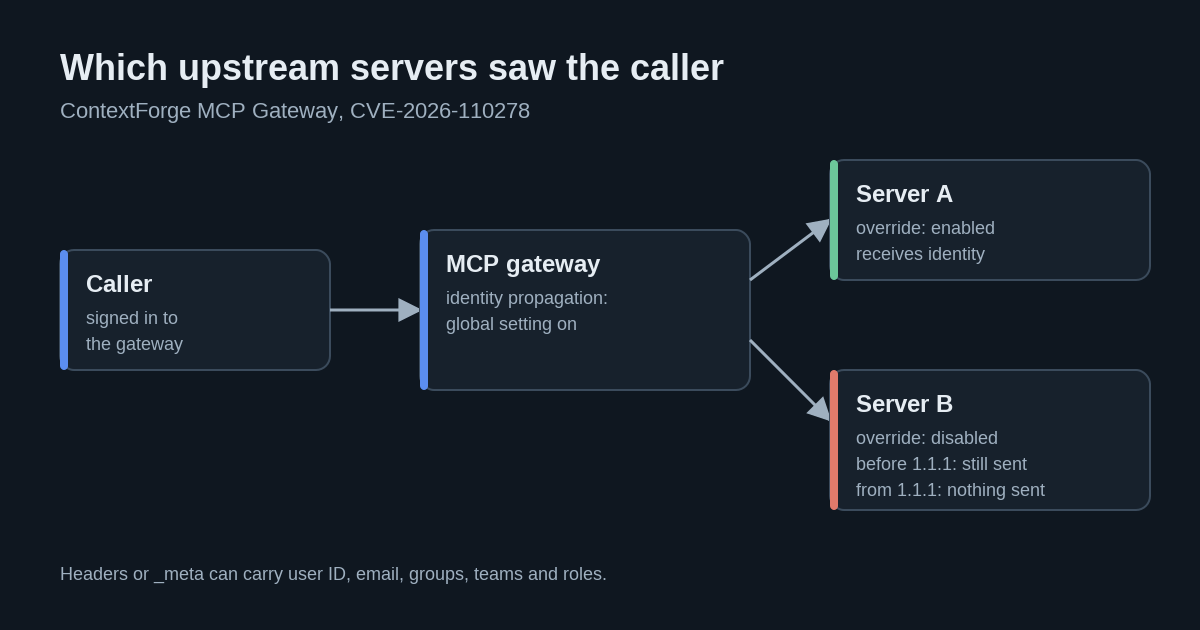
An MCP gateway knows who is calling. Whether it tells the MCP servers behind it is a deliberate choice, and one that differs by server: an internal service may need the caller's email and groups to authorise a request, while a third-party server shouldn't see them at all. On 12 November 2026 IBM published a bulletin for ContextForge MCP Gateway, an open-source gateway, for a flaw in exactly that choice. When identity propagation was on globally, tool calls and resource reads ignored a server's own setting to turn it off, so user identity reached servers configured not to receive it. The fix is in version 1.1.1.
What the bulletin says
The IBM security bulletin explains that ContextForge "can forward the identity of the calling user (such as user ID, email address, groups and teams) to upstream MCP servers when identity propagation is enabled", and lets operators turn this on or off for each registered upstream server. Because "the per-server identity propagation setting is ignored when invoking tools and reading resources", identity could go to servers set not to receive it.
- CVE: CVE-2026-110278.
- Affected: ContextForge MCP Gateway v1.0.0 to v1.1.0.
- Fixed: v1.1.1, which IBM says to install "immediately".
- Score: CVSS 3.1 base score 7.4, vector
AV:N/AC:H/PR:N/UI:N/S:U/C:H/I:H/A:N, which is in the "high" band. - Workaround: if you can't upgrade, set
IDENTITY_PROPAGATION_ENABLED=falseso that no upstream server receives identity, and restrict gateway access to trusted users.
Two descriptions, one CVE
The bulletin's summary and its CVE description don't say quite the same thing. The summary describes only the ignored per-server setting. The CVE description adds that an attacker could "replay identity propagation claims signatures" because of "static signature payloads", and the listed weakness is capture-replay (CWE-294).
The v1.1.1 release notes and the fixing pull request #7329 help separate the two. The pull request carries two fixes under one internal issue. The first makes tool calls and resource reads honour the per-server identity_propagation override; the release notes file it under CWE-200 and say a server set to enabled: false "now receives no identity headers or _meta". The second binds webhook notification signatures to a timestamp and delivery ID to prevent replay. That webhook protection is opt-in through hmac_include_timestamp, which defaults to false in 1.1.1, with the release notes saying the default will flip in a later minor release.
Neither the release notes nor the pull request describes a change to how identity claims themselves are signed. The identity propagation documentation says the optional claims signature "covers the canonical JSON representation of the identity payload", and lists no timestamp or nonce. If your upstream servers rely on that signature, treat replay as a question to raise with the project rather than one 1.1.1 settles.
Who was exposed
According to the pull request's review, the blast radius is deployments with global propagation on and a per-server override of off. The documentation lists what propagation can carry in headers or MCP _meta: user ID, email, admin status, groups, teams, roles, authentication method, team, service account and delegation chain. Propagation is off by default (IDENTITY_PROPAGATION_ENABLED is false), so a deployment that never turned it on wasn't sending identity at all.
Note what wasn't affected: the issue concerns which servers receive identity, not whether the gateway authenticates its callers. Nor does the bulletin say that tool arguments or results went anywhere they shouldn't. The exposure is the identity attributes themselves, which for many organisations include names, email addresses and group memberships that count as personal data, so a privacy review may be needed as well as a patch.
What it means for engineering and security leaders
Gateways concentrate decisions. That is their value, and it also means a single ignored setting changes behaviour for every call that crosses them. Here the setting was a privacy control, and the failure was silent: nothing broke, servers simply received more than intended. An operator reading the configuration would have believed the opposite of what was happening.
There is a broader design lesson. Forwarding identity in headers asks every upstream server to trust whatever the gateway sends, and makes those headers attractive to anyone who can capture or forge them. ContextForge also supports RFC 8693 token exchange, which the documentation describes as strictly opt-in per gateway, and 1.1.1 adds delegation tokens to it. With token exchange, the upstream receives a token issued for that user by your authorisation server, rather than a set of headers. Where an upstream server supports it, that is a stronger way to tell it who is calling.
Practical takeaways
- Upgrade ContextForge to 1.1.1 if you run 1.0.0 to 1.1.0.
- Check whether you were exposed. Look for global
IDENTITY_PROPAGATION_ENABLED=truecombined with any server whoseidentity_propagationhasenabled: false. Those servers received identity until the upgrade. - Tell the owners of those servers. If any are run by a third party, ask what they log and how long they keep it.
- Prefer an allow-list. Turn propagation on per server where needed, and use
allowed_attributesto send only what each server needs. - Don't rely on static signed headers alone. Where possible, use token exchange so upstream servers get a short-lived token for the right audience.
- Turn on timestamped webhook signatures with
hmac_include_timestamp: trueonce your receivers verify the new format.
SpanDock's MCP gateway (Premium and Enterprise plans) takes a different approach to the same question: connector credentials stay on the server, and a connector can use one shared sign-in or each person's own account, so the service's own permissions apply. Every call is recorded with the person and computer, and arguments and results are recorded only if an administrator turns that on.
Sources
- IBM Security Bulletin: IBM ContextForge MCP Gateway is affected by an information exposure vulnerability (CVE-2026-110278, 12 November 2026)
- ContextForge v1.1.1 release notes (IBM/mcp-context-forge, 10 November 2026)
- ContextForge pull request #7329: bind webhook HMAC to timestamp and honor per-gateway identity propagation
- ContextForge documentation: Identity Propagation