
Qwen4-Max pricing: why the cut depends on the region you call
Qwen4-Max launched on 16 November 2026. Its list price is 25% below Qwen3.8-Max in Singapore but about 14% lower elsewhere, and its cache has two lifetimes.
Alibaba Cloud released Qwen4-Max in Model Studio on 16 November 2026, five days after a preview that was offered only through its Token Plan. The release positions it for coding, frontend work and complex agentic tasks, with tool calling, structured outputs and compatibility with the OpenAI and Anthropic APIs. Against the previous flagship, its list price is 25% lower in Singapore. That figure holds for one deployment, and not for the others. For teams choosing models for coding agents, the pricing page is worth reading line by line, along with the new cache options that come with it.
What was released
The Model Studio release notes list qwen4-max on 16 November 2026 under Singapore, with an International deployment scope. They describe it as "the next-generation flagship multimodal model in the Qwen family", combining text generation, image and video understanding, and reasoning, designed for "coding, office productivity, frontend design, and complex agentic tasks". The same page lists qwen4-max-preview on 11 November 2026, available "through Token Plan only".
The release notes give no benchmark figures. Before routing coding work to it, run it on your own tasks.
The price, by region
The Model Studio pricing page lists Qwen4-Max with one price band for requests of up to 1 million input tokens, the same price for thinking and non-thinking modes, and output priced as "chain of thought + answer". Prices are per million tokens:
| Where | Input | Output | Previous flagship (qwen3.8-max) in the same table |
|---|---|---|---|
| Singapore (International) | $1.50 | $4.50 | $2.00 input, $6.00 output |
| China (Beijing), Hong Kong, Frankfurt, Virginia, Tokyo | $1.413 | $4.24 | $1.65 input, $4.951 output |
In Singapore the new model is 25% cheaper than Qwen3.8-Max on both input and output. In the other regions listed, the drop is about 14%, from $1.65 to $1.413 for input and from $4.951 to $4.24 for output. Qwen4-Max is still cheaper in those regions in absolute terms, but if you plan with the 25% figure and call it from Frankfurt or Virginia, your savings estimate will be too high.
There is no long-context step in the table: one price applies up to 1 million input tokens. That matters for agent loops, which grow their context with every turn. Compare a model whose rate rises past a threshold, as in Muse Ember's 200K cliff.
The Singapore listing also includes a free quota of 1 million tokens, valid for 90 days from activation, model release or approval, whichever is later.
Caching: two lifetimes, two break-even points
For agents, caching often matters more than the headline rate, because each turn resends a long and mostly unchanged prefix: system prompt, tool descriptions, files read earlier. The pricing page lists three cache prices for Qwen4-Max. In Singapore they are $1.875 for a 5-minute cache write, $3 for a 1-hour cache write, and $0.075 for a cache read; in the other regions, $1.767, $2.827 and $0.071.
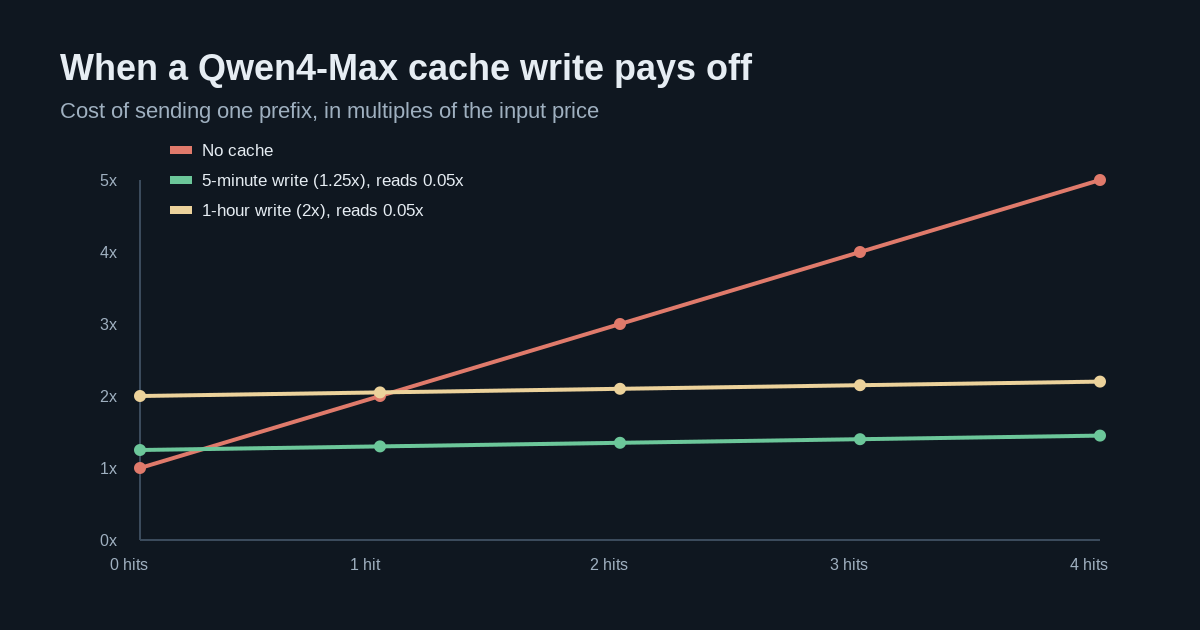
As ratios of the input price, that is a 5-minute write at 1.25 times, a 1-hour write at 2 times, and a read at 5%. The arithmetic follows from that:
- 5-minute cache: the write costs 0.25 times the input price more than sending the prefix uncached. Each hit saves 0.95 times. It pays for itself at the first hit.
- 1-hour cache: the write costs a full extra input price. It pays for itself from the second hit within the hour.
The Qwen4 explicit cache documentation explains how to use them. You can turn on automatic caching or mark cache breakpoints, and set a time-to-live of 5 minutes or 1 hour. The cached prefix must be at least 1,024 tokens, a hit requires an exactly identical prefix, and caches are reused only across requests from the same user. The page advises putting content that stays the same at the beginning. Without cache parameters, the implicit cache applies, and hits are not guaranteed.
A discrepancy to note
The general Context Cache page says explicit cache hits are "typically" billed at 10% of the input price and implicit hits at 20%. The Qwen4-Max row of the pricing table lists a single read price for "explicit/implicit cache read", at 5% of input. The general page uses the word "typically" and points to the billing tables, so the table should govern, but check your first invoice against it.
What it means for engineering and model-choice leads
The useful number for a coding agent isn't the list price but the price of a typical session: how much of each request is a reused prefix, how often the cache is hit, and how much the model writes. With a 5% read price, a long, stable prefix can make the input side much cheaper than the list rate suggests, provided the client actually marks or triggers caching and keeps the prefix unchanged. The 1-hour lifetime suits agents with gaps between turns, such as a person reviewing output before continuing; the 5-minute lifetime suits tight loops.
Region is the other variable. The cheaper price outside Singapore and the different relative cut both depend on where you call the API from, which in turn may be fixed by data-location requirements. Check which region your organisation is allowed to use before comparing prices.
Practical takeaways
- Price it for your region. Use $1.50 and $4.50 for Singapore, $1.413 and $4.24 for the other listed regions.
- Don't reuse the 25% headline outside Singapore; plan with about 14%.
- Turn on caching deliberately. Use automatic caching or breakpoints, put stable content first, and choose the 1-hour lifetime only where turns are minutes apart.
- Measure hit rates, not just token counts, during a trial.
- Evaluate on your own tasks before routing work to it; the release notes give no benchmark figures.
If you run calls through SpanDock's model proxy, costs that a tool doesn't report are estimated from a price catalogue, and your own overrides under Settings → Model prices take priority. Setting the price for the region you actually call keeps estimates for a new model in line with your bill.