
MCP Inspector 2.14.0 closes three flaws in the reviewer's workbench
Inspector 2.14.0 patches a sandbox escape in MCP Apps, hidden commands in server.json imports, and a schema regex stall. Who is affected and what to upgrade.
In late October the official MCP debugging tool shipped a batch of high-severity fixes. Two weeks later it needed another release for a quieter class of bug: the workbench people use to review a third-party MCP server was trusting its own sandbox, its own import preview and a server-supplied schema a little too far. MCP Inspector 2.14.0, published on 4 November 2026, patches three privately reported flaws in the v2 line. None is rated critical. Together they show why a reviewer's tool has to treat the server under test as hostile, even when the reviewer's job is only to look.
What 2.14.0 fixed
The release notes list three vulnerabilities, each with its own advisory. All three affect @modelcontextprotocol/inspector from 2.0.0 through 2.13.0. The upgrade command the project gives is npx @modelcontextprotocol/inspector@latest. One of them also affects the deprecated v1 line, where it is fixed in 1.0.4.
The maintainers also raised the advertised Node floor to the October 2026 security releases. npm prints EBADENGINE on older versions; the field is advisory and the Inspector still runs. Treat that as hygiene, not as the security fix.
A sandbox that survived a navigation
GHSA-h9j8-vj8g-v3gg, published on 5 November and rated moderate (CVSS 3.1 6.1), sits in the web client's MCP Apps tab. On the default opaque-origin path an app is loaded in a srcdoc frame behind a content security policy. A reviewer who looks at that policy can believe the app may only contact the hosts it declared.
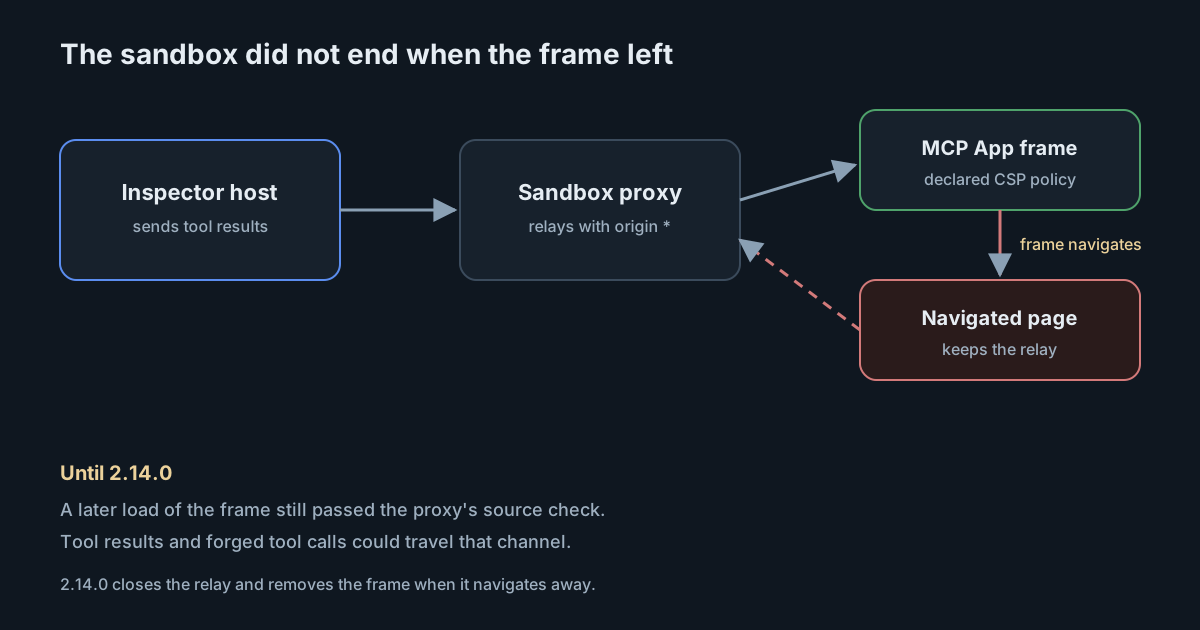
The advisory says that belief does not hold. An app can navigate its own frame to another origin. Sandbox flags persist across that navigation, so the new page still has a null origin and still passes the proxy's check that a message came from the inner frame. The proxy also keeps relaying host messages to it with a wildcard target origin.
The reporter reproduced three consequences: data leaving despite a CSP that forbade network connections; the attacker's page later receiving a tool result the host sent to the app; and the host accepting a tool call posted by the attacker's page as if the original app had sent it. In the advisory's words, the per-app connectDomains allowlist "is not an egress boundary."
Who is affected is narrower than the earlier Inspector remote-code-execution issues. The advisory says CLI and TUI users are not affected, anyone who never opens the Apps tab is not affected, and apps that request a dedicated origin through _meta.ui.domain load through a different path. The realistic threat is a malicious or compromised MCP server whose app a person then opens to inspect, not unauthenticated access to the Inspector itself. The advisory calls the issue "more serious for anyone who uses the Inspector to vet third-party apps, since its whole value there is showing reviewers what an app can reach." For a developer testing their own trusted app, the practical risk is described as low. A CVSS 3.1 score of 6.1 is moderate, not high: network reach, required user interaction, a change of scope, and low confidentiality and integrity impact.
The fix in 2.14.0 is to treat a later load of that frame as a navigation away: the proxy closes the relay, removes the frame and tells the host why. The release notes put it plainly: an MCP App can no longer navigate its sandbox frame away from the policy it was given.
An import that hid the command
GHSA-rwv7-mh2c-ff2p, also published on 5 November and rated moderate, covers two input-validation weaknesses. The advisory does not publish a CVSS number in the same way as the other two; we therefore describe it only as moderate.
The first weakness is in how the Inspector imports an MCP Registry server.json document. Runtime arguments from that file were spliced into the command used to start the server (npx, uvx, docker run or dnx) without filtering flags, and the package identifier was not checked for a leading dash. The web UI then concealed what would actually run: after a second the raw JSON preview collapsed, and the panel showed a registry type, package name and runtime hint rather than the resolved command and arguments.
The result, in the advisory's words, is that an imported file can pass extra runtime flags "while displaying a benign package identifier in the UI." That is the same class of mistake we wrote about when an MCP server entry turned out to be a command: what you think you are installing and what will be executed can differ.
The second weakness is in how the web client opened elicitation URLs and how it injected a CSP into HTML previews. The elicitation dialog passed the requested URL to window.open without checking that the scheme was http: or https:. Separately, the HTML preview injected its CSP meta tag with a regular-expression replacement on the first <head it found, which could land inside a comment instead of in the real document head.
2.14.0 makes the import show the exact command before it is saved, and rejects a package with an invalid or empty environment-variable name or unsafe tokens. URL elicitations now open only http and https URLs; any other scheme is refused, with a reason. The HTML preview's CSP now precedes all document markup.
A schema that could stall the UI
GHSA-2fw8-7jmw-r937, published on 4 November and rated moderate (CVSS 3.1 6.5), is the issue that also landed in v1 as 1.0.4. After a user calls a tool, Inspector validates the server's result against the server's own outputSchema, including any regular-expression pattern, synchronously on the UI path. There was no complexity limit or timeout.
A server that advertises a pathological pattern and then returns a near-match string can make that validation take an impractical amount of time. The advisory's tests with AJV 8.20.0 showed nonlinear growth into practical stalls as the input lengthened. The user has to connect and invoke the tool. The advisory reports no information disclosure, integrity violation or remote code execution: the 6.5 score is driven by high availability impact with no confidentiality or integrity loss.
2.14.0 checks server-supplied schema patterns in bounded time. Tool-output and app-elicitation schemas use a linear-time matcher with per-pattern and per-schema limits. A pattern beyond those limits is reported as unverified instead of being evaluated. People still on the deprecated v1 line should move to 1.0.4 for this fix alone; the other two advisories do not list a v1 patch.
How this sits next to the October advisories
We covered Inspector's nine October advisories when they landed. Those were a different set of bugs, including issues that reached remote code execution. 2.14.0 is not a recap of that batch. It is three new reports, disclosed on 4 and 5 November, about rendering an app, importing a server description and validating a tool result. The shared lesson is the same as in download counts are not trust: an official debugging UI and a registry document are not themselves a reason to trust the server under review.
What it means for engineering and security leaders
Treat the Inspector as part of the same attack surface as the servers it inspects. A reviewer who opens a third-party app is asking the workbench to render untrusted UI and relay host messages to it. Until 2.14.0, a CSP allowlist was not enough to bound that UI. Treat server.json imports as command construction, not as a package name, and read the resolved command before saving.
Do not run an older Inspector "just to look." Looking is the moment these bugs fire. Upgrade the v2 line to 2.14.0 or later, and move any remaining v1 installs to 1.0.4. Confirm the running version: npx without a pin can surprise you, and the Node warning does not stop the process.
These patches do not replace access control on the MCP servers your agents call in production. The Inspector is a review and debugging tool. Production agents still need permissions, approvals and an audit of what was called.
Practical takeaways
- Upgrade
@modelcontextprotocol/inspectorto 2.14.0 or later on every machine that runs the web client. If you still start the deprecated v1 line, install 1.0.4 for the schema-stall fix. - Anyone who reviews third-party MCP Apps should not treat a pre-2.14.0 CSP allowlist as proof of where an app can send data.
- When importing a
server.jsonfile, read the resolved command and arguments before saving. A friendly package name is not the command. - Track the Inspector version the same way you track other developer tools that spawn commands or render third-party UI.
In SpanDock, the MCP gateway (Premium and Enterprise plans, and in the 30-day trial) is the production control that sits in front of your organisation's connectors: every computer's AI tools call one MCP server, the server applies permissions and approvals, credentials stay on the server, and every call is recorded. That is a different layer from the Inspector, which remains a review and debugging tool you should still keep patched.
Sources
- MCP Inspector advisory GHSA-h9j8-vj8g-v3gg: MCP App escapes its CSP by navigating its own frame
- MCP Inspector advisory GHSA-rwv7-mh2c-ff2p: unvalidated server.json import arguments and URL schemes
- MCP Inspector advisory GHSA-2fw8-7jmw-r937: Inspector can stall on a malicious tool output schema regex
- MCP Inspector 2.14.0 release notes