
After the eMudhra CA compromise, browsers moved in hours. Check your runtimes
Browsers blocked the compromised eMudhra intermediate CAs within hours. Runtimes, certificate bundles and container images update on their own schedules.
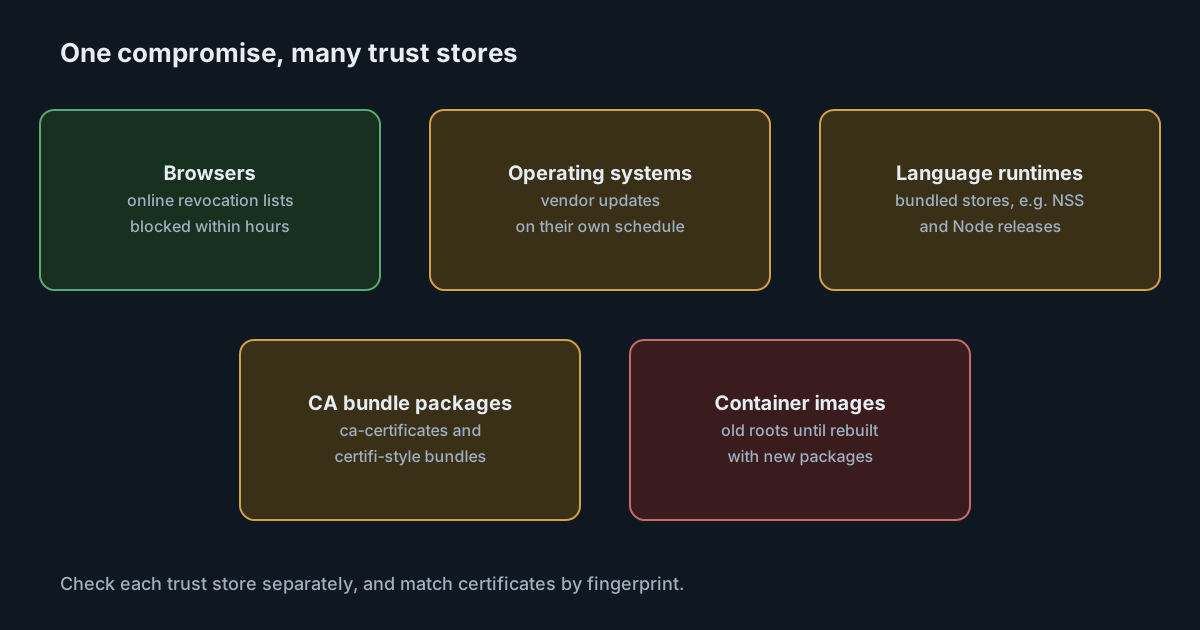
In mid-October 2026 the private keys of several eMudhra intermediate certificate authorities turned out to be weak enough to recover, which would let anyone holding them issue HTTPS certificates that browsers trust. Chrome, Firefox and Windows blocked them within hours, without anyone installing anything. That speed is the good news. The rest of the story is about everything that isn't a browser: the language runtimes, certificate bundles and container images that your build systems, services and AI coding tools use to make HTTPS calls. Those have their own trust stores, and each updates on its own schedule.
What happened
The accounts from the browser and operating system vendors agree on the outline. Google says its root program received the report on 17 October at 18:05 UTC, and that the keys had been "generated with insufficient randomness". Chrome blocked six TLS intermediates by their public keys through its online CRLSet list at 19:45 UTC the same day, and Android followed through Play services. Google also says no TLS certificates from those six intermediates had been logged to Certificate Transparency before the block.
Mozilla received its report at 20:06 UTC and finished its own block, through the OneCRL list, at 22:59 UTC. It then shipped Firefox 158.0.1 and ESR updates on 20 October for users whose settings bypass OneCRL.
Microsoft counts eight affected keys, six for TLS and two for code signing. It added them to the Windows disallowed list on 20 October, released an out-of-band Windows update on 26 October that removes seven certificates from the trust list, and warns that software which doesn't check revocation or the disallowed list may still trust them.
eMudhra's own statement says the intermediates were created at a key ceremony on 30 April 2025, that a key wrapping step produced the weak keys, and that it revoked them on 18 October. It says about 30,800 certificates under the affected hierarchies belong to one client ecosystem in the United States, which is moving to another eMudhra root, and that it is winding down public TLS issuance.
Where the sources disagree
Two differences are worth knowing before you search your own systems.
- What the intermediates were for. eMudhra describes them as intermediate TLS CAs. Microsoft says two of the eight keys were for code signing. If you only search TLS configuration, you may miss the code-signing side on Windows.
- Which roots were removed. Mozilla and Google name the root they removed as emSign ECC Root CA - G3. The NSS 3.131.1 release notes list one change as removing "eMudhra emSign Root CA - G3", and a separate change removing emSign Root CA - C1 and emSign ECC Root CA - C3. eMudhra says the C1 and C3 removal was voluntary and already planned. Search by fingerprint, not by name.
Why browsers were not the end of it
Browsers fetch revocation lists of their own, so a block reaches users within hours. Most other software only knows the roots it was built with.
The Mozilla root store travels. Many tools don't use the operating system's store at all, but a copy of Mozilla's list, packaged by NSS. Mozilla released NSS 3.131.1 on 20 October specifically to protect applications that use its root store without OneCRL. Every copy of that list, in every package and image, has to be updated separately.
Node.js bundles its own roots. The Node.js security releases on 20 and 21 October, including 24.22.1, 22.23.4 and 26.12.1, update the bundled root certificates to NSS 3.131.1 and add a change that rejects chains containing blocked public keys. Many AI coding tools and MCP servers run on Node.js, often a copy bundled with the tool.
Python's certifi moved several times. The package that gives many Python programs their roots changed four times in a few days. Version 2026.10.18 removed all emSign roots, 2026.10.19 restored three of them (not ECC G3), and 2026.10.23 kept only emSign Root CA - G1. If a lock file pins a version from before 18 October, the affected root is still trusted.
Container images freeze all of this. A base image built before 20 October carries the operating system's certificate bundle, a runtime's bundled roots and any pinned certifi, all from before the fix. Only a rebuild that installs the new packages fixes it; an image pinned by digest, or a stale cached layer, keeps the old roots.
What it means for engineering and security leaders
- Revocation that works in browsers proves little about servers. The question to ask is which trust store each service actually uses, and how it gets updated.
- AI tools add trust stores. Coding agents, MCP servers and model gateways make many outbound HTTPS calls, often through a bundled runtime. They belong in the same inventory as your services, alongside the URL checks we covered in MCP servers keep trusting the wrong URLs.
- Treat trust stores as dependencies. The fix arrived as package releases: a new NSS, new Node.js versions, new certifi versions. Your usual dependency process is the right channel, if it reaches base images and bundled runtimes. As with packages, as we argued in Download counts aren't trust, what you trust should be a decision you can check, not a default.
Practical takeaways
- Update Node.js to a release from 20 October or later on each supported line, and check tools that bundle their own Node.js.
- Update certifi to 2026.10.23 or later wherever Python is pinned, and look for vendored copies of its bundle.
- Rebuild container images rather than relying on cached base layers, then confirm the bundle inside the image no longer contains the affected root.
- Search trust stores by certificate fingerprint rather than by name, since the vendors' names for the same roots differ.
- On Windows, check that machines without automatic certificate trust updates have the 26 October out-of-band update, and remember the code-signing keys.
Sources
- Mozilla Security Blog: Protecting Firefox users following the compromise of eMudhra intermediate certificates
- Google: Protecting Chrome and Android users from compromised eMudhra intermediate CA certificates
- MSRC: Microsoft's response to compromised eMudhra certificate authority keys
- NSS 3.131.1 release notes
- eMudhra statement on recent certificate security incident
- Node.js v24.22.1 security release