
NeMo Agent Toolkit's critical bulletin: acting on an advisory that says little
NVIDIA rated a NeMo Agent Toolkit missing-authentication flaw CVSS 10.0, fixed in 1.9.0. The bulletin doesn't say where it is. How to respond.
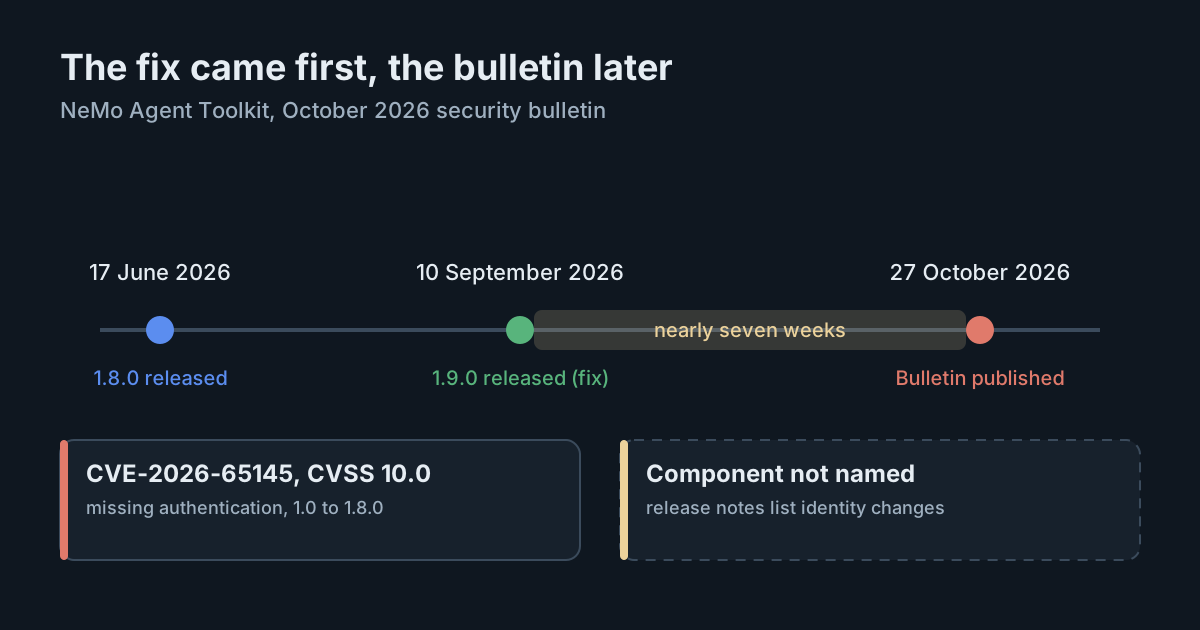
On 27 October 2026, NVIDIA published a security bulletin for NeMo Agent Toolkit, its open-source library for building, connecting and profiling AI agents. One of the two flaws is rated critical, with the maximum CVSS score of 10.0, for missing authentication. The bulletin says which versions are affected and which one fixes it. It does not say which part of the toolkit is affected, how it is reached or what an attacker needs. Teams running agent services built on it have to decide what to do with very little to go on.
What the bulletin says
The NVIDIA bulletin lists two CVEs:
| CVE | Weakness | CVSS 3.1 | Affected | Fixed in |
|---|---|---|---|---|
| CVE-2026-65145 | Missing authentication (CWE-306) | 10.0, critical | 1.0 to 1.8.0 | 1.9.0 |
| CVE-2026-65151 | SQL injection (CWE-89) | 8.4, high | 1.4 to 1.6 | 1.7.0 |
The critical one has a network attack vector, low complexity, no privileges and no user interaction required, and a changed scope, with high impact on confidentiality, integrity and availability. NVIDIA lists the possible impacts as code execution, escalation of privileges, data tampering, denial of service and information disclosure. The SQL injection is rated lower mainly because its attack vector is local.
Both were found outside NVIDIA. The bulletin credits Colin McDonough of 50words.com for both, and YJK of ZUSO ART, working with the TrendAI Zero Day Initiative, for the authentication flaw. The NVD entry repeats NVIDIA's description and score.
The bulletin's guidance is to clone or update to 1.9.0 or later from the GitHub repository. Its own version table says the update is "available from nvidia.com". The toolkit is distributed through GitHub and the Python Package Index, so take the GitHub wording as the instruction.
What it doesn't say
The description of CVE-2026-65145 says only that the toolkit "contains a vulnerability where a attacker could cause a missing authentication issue". There is no component, no endpoint, no configuration and no indication of whether the default set-up is exposed. NVIDIA's standard note applies too: its score reflects "an average of risk across a diverse set of installed systems" and may not match yours.
The fix did not arrive with the bulletin. Version 1.9.0 was released on 10 September 2026, nearly seven weeks earlier. Its release notes contain several changes about identity and authentication, and the bulletin doesn't say which of them addresses the CVE. Among them:
- Breaking: removal of
local_sandbox, with code execution left to the remote Piston sandbox; theuser_idparameter no longer exposed to the model; and improved user identity resolution. - WebSocket: reconnection to a conversation bound to the user's identity, and configurable identity credentials for WebSocket connections.
- Authentication: an OAuth2 client isolated per flow in the console and MCP authentication handler, and preflight authentication for providers that support it.
Pull request 2197, "Improved user identity resolution", is a good illustration of what changed. It makes trusting an identity header opt-in through an identity_header setting, documents when relying on a header is and isn't safe, removes a fallback to a default user in the memory wrapper, and applies JWT improvements to all endpoints rather than only WebSockets. We can't say from the public record that this is the fix for the CVE. It does show that 1.9.0 changed how the toolkit decides who is calling, and that some of those changes are breaking.
Why vague advisories still need a response
It is tempting to wait for details. That is usually the wrong call when the score is 10.0, the fix has been public for weeks and the release notes point at the area. Anyone comparing 1.8.0 and 1.9.0 can see what changed, so the absence of detail in the bulletin protects attackers' time less than it costs defenders.
There is a familiar pattern here too. We have written about fixes that shipped long before their advisories: teams that upgrade on release are protected early, and teams that wait for advisories are exposed for the whole gap. The other lesson is about where agent controls live. A framework's own authentication is one layer; as we wrote when NVIDIA released OpenShell, controls outside the agent process are what still hold when that layer fails.
What it means for engineering and security leaders
- Know where agent frameworks run as services. A library on a developer's laptop and a toolkit serving HTTP or WebSocket endpoints on a shared network are very different risks. Your inventory should say which is which.
- Breaking changes delay security fixes. Version 1.9.0 removes a sandbox and changes how identity is resolved. Teams that pinned 1.8.0 to avoid that work are still on an affected version. Budget time for framework upgrades the way you do for operating system patches.
- Ask vendors the missing questions. Which component, which configuration, and is the default exposed? A vendor's answer belongs in your risk record, and so does the lack of one.
Practical takeaways
- Search lockfiles and images for NeMo Agent Toolkit packages (on the Python Package Index,
nvidia-natand its plugin packages) and record the resolved versions. Anything from 1.0 to 1.8.0 is affected by the critical flaw. - Upgrade to 1.9.0 or later, reading the breaking changes first:
local_sandboxremoval,user_idhandling and identity resolution. - After upgrading, check whether you need
identity_header, and only enable it behind a proxy that sets the header itself. - Until you have upgraded, keep any toolkit service off untrusted networks and behind an authenticating proxy.
- If you run 1.4 to 1.6, the SQL injection fixed in 1.7.0 applies as well; moving to 1.9.0 covers both.
- Subscribe to NVIDIA's product security notifications and watch the toolkit's releases directly, since the release came first here.